Showing posts with label HSDPA. Show all posts

Tuesday, April 9, 2013

Mobile Number Portability (MNP) in Nigeria...the Game Changer


In a matter of months, Nigeria will join the group of countries that have implemented the Mobile Number Portability (MNP). Nigeria will become the fourth African country after South Africa (2006) Egypt (2008) and Ghana (2011).
One would be tempted to ask  "What really is MNP and how does it benefit the Nigerian subscriber?"

Mobile number portability (MNP) enables mobile telephone users to retain their mobile telephone numbers when changing from one mobile network operator to another. In Nigerian terms, it implies that MNP allows me to use my MTN number on Etisalat network (for example), enjoying all the benefits open to original Etisalat subscribers.
So what's the big deal you're still asking? Imagine you had GSM number that all your friends, family and business associates use to contact you, but you weren't satisfied with the services of the telecom operator. You would be forced to hold onto this line just to ensure you're easily accessible. MNP allows you to migrate your line to any other network f your choice while retaining your number.
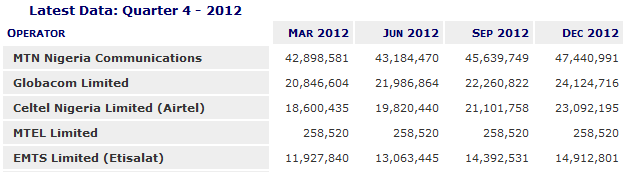
Quarterly Market Share for 2012 (Coutesy: NCC)


The table above gives an insight into the market share of the telecoms industry though recent reports confirm that Airtel and Etisalat have significantly increased their market shares at the expense of Glo and MTN. Currently about one(1) in every four(4) subscribers in Nigeria is an MTN subscriber and a lot of these subscribers are inching for better voice and data services.
 Assuming the ideal MNP operations, we will experience an interesting trend in subscriber migration to other networks with better services. Etisalat and Airtel will be the biggest beneficiaries in my opinion as the recent trends show them increasing their market share. I believe MNP will further consolidate this trend. Glo on the other hand have a very good chance to reclaim their market share as well if they are more innovative in their products and services while MTN will also try to keep as much of its subscribers as well to maintain their advantage.
 However, we will also experience a drop in the total number of mobile subscribers, the reason being that asubcriber won't have the need to own more than one or two active phone lines, that's provided initial MNP operations are successful.
 Therefore, it appears MNP is not just a threat to the market leaders, in this case, MTN but to all operators. Well not exactly as there are some factors that might work for or against the operators.
  • Subscriber awareness and enlightenment of MNP Subscribers need to have a good understanding of MNP before they can subscribe to the concept.
  • Subscriber Behaviour its easier and faster to buy another network's SIM card than to port to that network so subscribers might shy away from MNP.
  • Faster Porting time The time to port is currently 2days which is far longer than it takes for a Sim Swap. This will deter intending subscribers if the porting time is not reduced considerably.
  • Interoperability between Operators As expected, the porting of subscriber on another network will not be devoid of snags and how this is managed will key in boosting the acceptance of MNP among subscribers.
This is an audacious yet laudable move by NCC and the early success or failure of this rests on their ability to effectively manage and work with the operators and third party companies such as Interconnect, Telecordia (Ericsson).

Like it or not, MNP is here to stay and will be a major factor in the face of the telecom market. Though, it won't be an immediate embrace by subscribers as modalities are still being worked out and rigorous testing ongoing at the operator side, it has come to stay and would on the long run serve as a deterrent to operators from offering poor services to their subscribers.

The bottom line is the subscriber should be KING.

Monday, April 8, 2013

Is HSPA+ 42Mbps the forbidden fruit ?


Have you ever wondered why you never get up to half the maximum HSPA+ download speed of 42Mbps?

Well the answers are not far fetched.

As much as telco operators want you to believe that you can get as much as 42 Mbps, its not possible to attain close to this. The following might explain why this is so

  •  The 3G/HSDPA USB dongles, modems that are commercially available are limited to maximum download speeds between 3.6Mbps to 10Mbps.
  • Most phones as well do not support such high download rates. Suprisingly, until the advent of smartphones did the maximum supported download speed did not exceed 5.76 Mnps
  • Most commercial SIMs are not provisioned for such download rates. 
  •  It is worth remembering that the speed of 42Mbps is a best effort speed i.e the maximum download speed in an ideal situation which hardly ever exists.
  • Lack of adequate resources or capacity to provide such download speed,
*Provisioning is the process by which services are granted to subscribers
 Nonetheless, you can still enjoy your internet experience even with a 3.6 Mbps 3G modem on a high speed data network but have it at the back of your mind that your maximum connection speed  is limited

Wednesday, April 3, 2013

Airtel to roll out Wi-Fi in 17 African countries...A Nigerian Perspective


Its obviously not news that Airtel Africa plans to launch WiFi in 17 African countries, though no official statement has been made yet by the company.

GigaOM has learned that pan-African operator Airtel is deploying a large-scale carrier Wi-Fi network using Ruckus and Alcatel-Lucent gear. With mainly 2G networks to its name today, Airtel will use Wi-Fi to jump start its mobile data services

WiFi is a popular technology that allows an electronic device to exchange data wirelessly (using radio waves) over a computer network, including high-speed Internet connections.

That being said, the primary reason for this move is to provide access to high speed internet to subscribers on predominantly 2G networks. Let me elaborate further that this means; on a 2G data network, the ideal data speeds for GPRS and EDGE are about 80kbps and 240kbps, however on WiFi, the speed ranges from 1Mbps to 150Mbps ( depending on the range and wireless protocol used). That's at least quadruple the capacity available on a 2G network.

In Nigeria, however, 3G, 3.5G and HSDPA, HSPA+ are available in major Nigerian cities and to my greatest surprise even in my village. (somewhere in Anambra State). HSPA+ is currently the fastest access technology in Nigeria as I write and stands at 42Mbps as advertised by Airtel, Etisalat and Glo, though nobody ever gets that much but that's another story for another day.
The advent of WiFi will allow cheaper non 3G phones to have access to high speed data which is really really cool as this is bound to increase the number of data subscribers on the African continent.

As cool as this sounds, my only grouse with this that Airtel plans to start in Niger as reported. No disrespect intended to Niger Rep. but from a business point of view, it just doesn't add up. Here's why I say so
  •  WiFi can serve as an alternative data access method and also serve as provide extra capacity especially in densely populated areas such as Lagos metropolis where almost all networks experience congestion.
  • Having worked on projects in both countries, and I can confidently estimate the number of active daily data subscribers in Airtel Niger to be between 11-15k, while in Nigeria, there are over 590k daily data subscribers. 
  • The growth in the telecommunication is unparalleled anywhere in the African continent. Nigeria added 5 million new mobile subscriptions in 2012 alone.
  • The launch of Mobile Number Portablity (MNP) will give them the advantage, attract new subscribers to their network and in turn increase their data subscriber base.
  • Data is very BIG business in Nigeria already. Soon data revenues will rival that of voice.
  • Nigerian subscribers are more active online than ever before, with Twitter, Facebook, Google+, Youtube, Whatsapp, BBM being very popular among the young generation.
Need I say more than I have already. Its a good initiative but it will yield much more if it is launched in Nigeria.